What Surface Textures Provide the Best Slip Resistance in Wet or Icy Conditions?
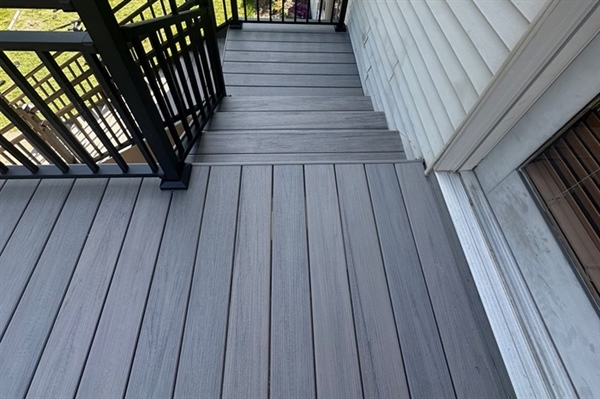
Surface texture plays a measurable role in how safely people move across outdoor walking areas, particularly when moisture or ice is present. Water reduces friction by forming a lubricating layer between footwear and the surface, while ice further lowers traction by limiting direct contact. Research in pedestrian safety and materials engineering consistently shows that textured surfaces disrupt this film, increasing the coefficient of friction and lowering slip risk. This is why textured finishes are standard in high-exposure outdoor environments across cold and wet regions, including residential decks, walkways, and stairs commonly built by Big Deck in Minnesota.
Understanding which surface textures perform best requires looking beyond appearance and into how different profiles interact with footwear, weather, and long-term wear. This article breaks down why texture matters for traction, compares grooved, brushed, and embossed finishes, examines slip-resistant decking materials suited for freezing climates, identifies high-risk areas that demand extra grip, and explains how maintenance affects long-term performance. These factors influence everything from material selection to layout design in outdoor spaces such as decks, where year-round safety depends on proven surface engineering rather than smooth aesthetics.
Why Surface Texture Matters for Traction and Safety
Surface traction is governed by friction, which depends on how effectively a walking surface maintains contact with footwear. In wet conditions, smooth surfaces allow a thin film of water to form between the shoe sole and the material, reducing friction and increasing slip potential. Ice compounds this problem by further limiting surface contact, leaving minimal resistance to lateral movement. Textured surfaces interrupt these films by creating raised contact points and channels that displace water, restoring friction at the point of contact.
Outdoor environments amplify these risks because precipitation, freeze–thaw cycles, and temperature swings constantly alter surface conditions. Materials with insufficient texture often perform adequately when dry but become hazardous when exposed to rain, snowmelt, or frost. Studies using dynamic coefficient of friction (DCOF) testing consistently show higher traction values on textured finishes compared to smooth ones, particularly when tested under contaminated conditions.
In deck construction, surface texture is not a cosmetic feature; it is a functional safety element. Builders working in northern climates rely on controlled surface profiles to maintain grip throughout the year, especially on elevated walking surfaces such as decks, where slips can result in more severe injuries due to height and edge exposure.
Grooved, Brushed, and Embossed Finishes Compared for Slip Resistance
Grooved finishes improve traction by introducing linear channels that move water away from the contact zone. These channels increase friction by allowing shoe soles to deform slightly into the grooves, creating mechanical resistance. Grooved profiles are effective in rain-prone environments, though their performance depends on groove depth, spacing, and orientation relative to foot traffic.
Brushed finishes rely on micro-texture rather than defined channels. By dragging stiff bristles across the surface during finishing, fine ridges are created that increase surface roughness. Brushed textures perform well under light moisture but may lose effectiveness when ice forms, as shallow ridges can become filled or smoothed by repeated freeze–thaw cycles.
Embossed finishes provide multi-directional texture designed to maintain grip regardless of walking direction. These finishes are molded into the material during manufacturing, creating consistent traction patterns across the surface. Embossed textures are often favored in engineered decking products because they maintain predictable slip resistance without relying on installation orientation.
Slip-Resistant Decking Materials for Wet and Freezing Climates
Composite decking materials are engineered with textured caps that improve slip resistance while limiting moisture absorption. Independent testing shows that capped composites with embossed grain patterns maintain higher friction values than untreated wood when wet. Their non-porous structure also reduces ice bonding, allowing snow and frost to release more easily during temperature changes.
Textured concrete achieves traction through surface finishing techniques such as brooming or stamping. When properly installed, these textures provide strong wet traction; however, concrete’s thermal mass allows ice to form and persist longer than on wood or composite surfaces. Anti-slip additives or surface coatings are often used to enhance performance in freezing conditions.
Treated wood with anti-slip profiles relies on mechanical texture from sawn or milled surfaces. While new installations provide acceptable traction, wood fibers compress and wear over time, reducing surface roughness. Rubberized coatings can restore grip but require regular inspection to maintain consistent friction under seasonal exposure.
High-Risk Areas That Require Enhanced Surface Grip
Stairs experience higher slip rates due to changes in elevation, foot placement variability, and edge loading. Textures with pronounced profiles or embedded grit perform best on stair treads, as they maintain friction even when partial ice coverage is present. Smooth stair nosings consistently rank among the highest-risk outdoor surfaces.
Pool decks and transition zones are exposed to continuous moisture, sunscreen residues, and temperature fluctuations. Textures that allow rapid drainage and resist chemical buildup perform better in these areas. Multi-directional textures reduce slip risk when users change direction or walk barefoot.
Entry zones accumulate water, snow, and debris from foot traffic. These areas benefit from textures that remain effective even when contaminated with dirt or organic material. Consistent surface roughness across thresholds helps prevent sudden traction changes that commonly cause slips.
How Surface Texture Holds Up Over Time With Maintenance and Wear
Surface texture degrades through abrasion, compression, and environmental exposure. Dirt and organic buildup can fill textured profiles, reducing their ability to disrupt water films. Algae growth further lowers friction by creating a slippery biofilm, particularly on shaded or north-facing surfaces.
Weathering alters texture depth as materials expand and contract. Wood fibers flatten, concrete edges round off, and composite caps polish under repeated use. These changes reduce friction unless surfaces are periodically cleaned and inspected using non-destructive methods.
Routine maintenance preserves traction by restoring surface definition. Pressure washing, appropriate cleaning agents, and avoiding surface-sealing products that reduce texture are key to maintaining slip resistance throughout the service life of outdoor walking surfaces.
Expert Guidance on Slip-Resistant Outdoor Surfaces
Big Deck.com designs and builds outdoor living spaces with safety and long-term performance in mind. Based in Minnesota, the company applies region-specific knowledge of freeze–thaw cycles, moisture exposure, and material performance to help clients select surfaces that maintain traction year-round. From textured decking profiles to stair and entry solutions, surface selection is approached with a focus on proven friction performance.
Big Deck works with homeowners to address traction challenges in high-risk areas using materials and finishes tested for cold-weather durability. For guidance on surface texture, material performance, and long-term maintenance, contact Big Deck at (612) 432-7761 or visit their contact us page.
